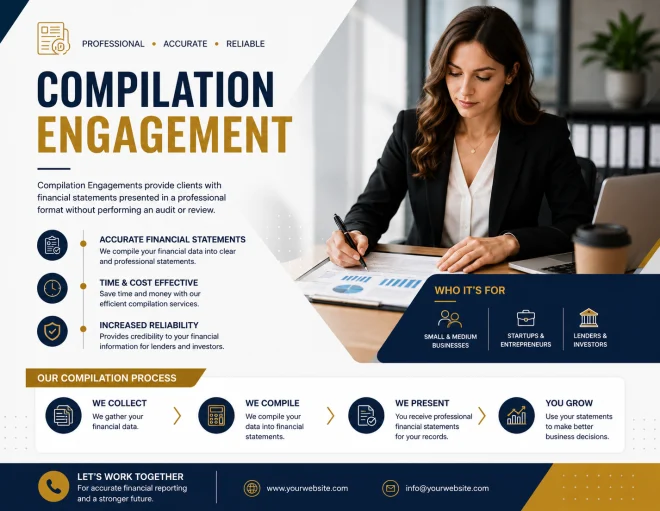
When a bank asks your Vancouver business for a compilation engagement, it is asking for CPA-prepared financial statements that show your results and financial position in a format a lender can actually read — without the cost of an audit or a review. In a compilation engagement, your accountant takes your business’s records and presents them as formal financial statements, with a Notice to Reader that states no audit or review was performed. For most small and mid-sized businesses in Vancouver, that is exactly what the bank needs to say yes.
What a compilation engagement includes
A finished compilation is a short package of statements. Each piece answers a question your bank will ask.
1. A Notice to Reader
The notice states that the CPA compiled the statements from information provided by the business, and that no audit or review was done. It tells the reader plainly that no assurance is given — which is why banks accept compilations for lending decisions where they are comfortable with the risk, but ask for a review or an audit when they need more.
2. A balance sheet
What the business owns and owes at year end: cash, accounts receivable, equipment, accounts payable, loans, and the owner’s equity. Your bank reads it to check liquidity and how much debt the business already carries.
3. An income statement
Revenue, expenses, and profit or loss for the year. Lenders compare it with prior years and with the figures in your loan application, so the numbers need to be consistent and explainable.
4. Notes to the financial statements
Short notes that explain the accounting policies used, related-party transactions, and anything unusual — a shareholder loan, for example, or a change in how inventory is valued. They stop the numbers from being misunderstood.
5. What it does not include
A compilation does not verify the records, test internal controls, or confirm balances with third parties. If a lender needs that level of assurance, it will ask for a review engagement or an audit instead. ABS will tell you honestly which one fits your request.
Why your bank asks for one
Banks usually ask for compiled statements when they need something more reliable than an in-house spreadsheet, but the size of the loan does not justify an audit. The usual triggers are a new business loan or line of credit, a mortgage or commercial property purchase, a loan renewal, financing through BDC, or a request to bring older, informal statements up to a professional standard.
A clean compilation also shortens the bank’s review. When the statements are prepared by a CPA-certified team and tie to the corporate tax return, the lender has fewer questions and less reason to ask for extra documents. ABS is a CPA-certified team with 15+ years of experience and 500+ clients across Canada, working virtually Canada-wide and in person in Vancouver.
Compilation vs. review vs. audit
The three differ in one thing: how much assurance the CPA gives.
- Compilation: the CPA presents your information as financial statements. No assurance is provided.
- Review: the CPA performs inquiry and analytical procedures and gives limited assurance that nothing came to attention suggesting the statements are misstated.
- Audit: the CPA performs detailed testing and gives reasonable assurance through an audit opinion.
Most small businesses a Vancouver bank sends to ABS need a compilation. If your lender has asked for a review or an audit by name, bring the letter — ABS will confirm the level of engagement before any work starts.
What to have ready before you call your accountant
A compilation moves quickly when the records are ready. Bring what you have, and ABS will work through the gaps with you.
- Bookkeeping records for the year — a trial balance or accounting and bookkeeping file that is up to date through year end.
- Bank statements and loan statements for the year, including year-end balances.
- The prior year’s financial statements and corporate tax return, if they exist.
- A list of shareholders, shareholdings, and any shareholder loans.
- Recent GST/HST filings, and details of any significant purchases or sales of equipment.
- The bank’s letter or email, so the statements match what the lender actually asked for.
If the bookkeeping is behind, that is where the work starts. A compilation is built on the books, so ABS will usually clean up the records first, then compile the statements and prepare the corporate tax return from the same set of numbers.
How long a compilation takes in Vancouver
It depends almost entirely on how complete the records are. A business with up-to-date books and a prior set of compiled statements to follow can usually be turned around far faster than one whose records need rebuilding. Year-end compilations are often prepared together with the corporate tax return, so the two agree. If your bank has given you a deadline, tell ABS when you book — the free 15-minute consultation is the time to agree on timing and a quote.
Meet ABS in Vancouver
ABS serves Vancouver from its office at 1500 West Georgia St, Suite 1300, Vancouver, BC V6G 2Z6, open Monday to Friday 8am to 9pm and Saturday 9am to 5pm. There is no direct Vancouver phone line — book through the consultation form on the Contact page, or meet by secure video from anywhere in Canada. The Vancouver office also serves Burnaby, Richmond, Surrey, North Vancouver, and West Vancouver.
Related reading from ABS

Corporate Tax Filing (T2) in Canada: Deadlines, Rates, and Filing
Deadlines, instalments, rates, and filing steps for Canadian corporations — plus how to avoid penalties.
Read more →
Bookkeeping for Small Businesses in Canada: A Practical Guide
A practical guide to books, receipts, and tax-ready records for Canadian small businesses.
Read more →Book your free 15-minute consultation
Tell us what your bank is asking for and when it needs it. ABS will tell you honestly whether a compilation is the right engagement, what to bring, and what it will cost — no obligation.