Short answer: every month, a Toronto small business should track income, expenses, bank and credit card balances, money owed to you, bills you owe, GST/HST, payroll, and cash flow. If those eight things are up to date, you know whether the business actually made money — not just whether the bank balance went up. If they are not, you are guessing, and the guess usually shows up at tax time, when it is too late to fix cheaply.
That is the whole job of bookkeeping: not paperwork for its own sake, but a monthly picture you can act on. This guide covers the eight things, how often each one really needs attention, and what clean books give you at year-end — for Toronto businesses, in Toronto’s tax setting.

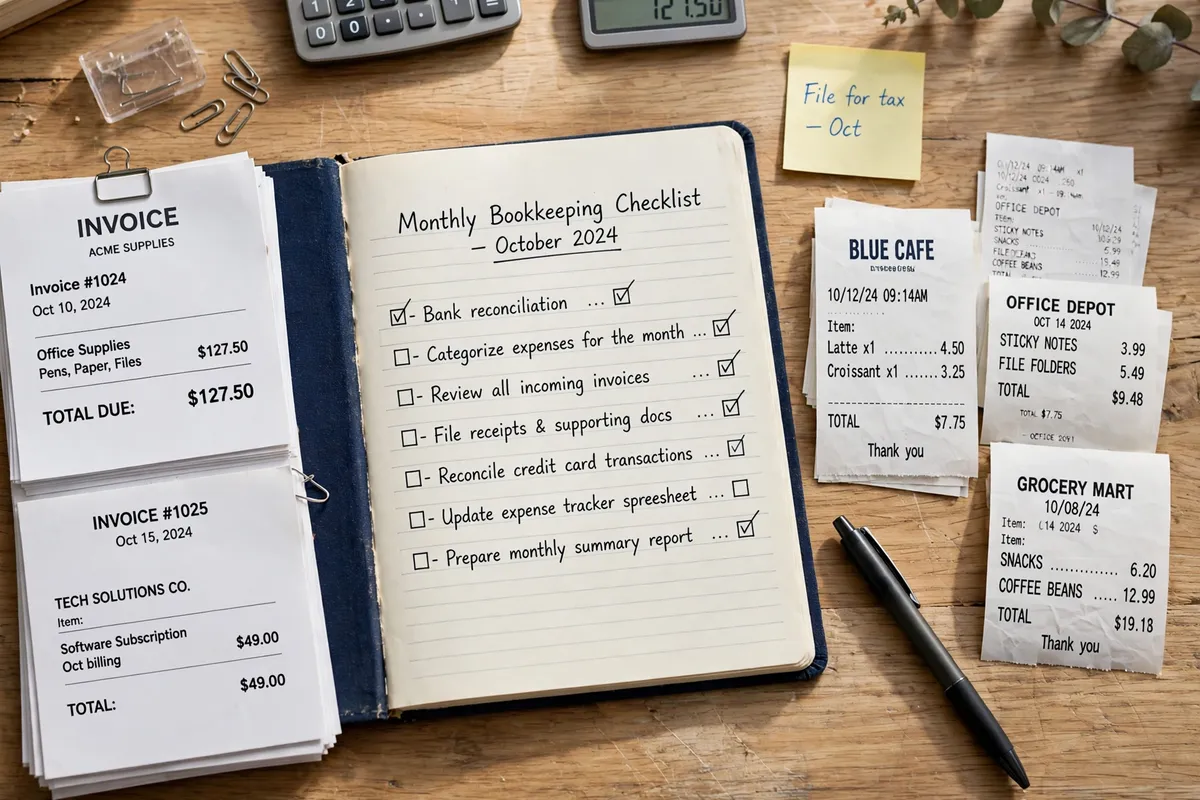
1. The eight things to track every month
| What to track | What to check | What goes wrong if it slips |
|---|---|---|
| Income | Every invoice issued, including ones clients have not paid yet | Revenue looks lower than it is; unpaid invoices get forgotten |
| Expenses | Every receipt and bill, matched to the right category | Deductions get missed; personal and business spending blur together |
| Bank and credit card balances | Reconciled against your books, every account | Errors and duplicate charges sit unnoticed for months |
| Money owed to you | Who owes what, and how old each amount is | Cash flow stalls while old receivables age quietly |
| Bills you owe | What is due, when, and to whom | Late fees, missed supplier terms, surprise payments |
| GST/HST | Tax collected on sales, tax paid on purchases | The wrong amount remitted; Ontario’s 13% HST applied incorrectly |
| Payroll | Wages, source deductions, and remittances | CRA payroll remittances fall behind — and penalties follow |
| Cash flow | Money in vs money out, for the next 30–60 days | A profitable month still ends with no cash to pay the bills |
None of these is hard on its own. The damage comes from letting them pile up: a month becomes a quarter, a quarter becomes the year-end, and then the cleanup costs more than the bookkeeping would have.
2. Monthly, quarterly, or once a year — what the frequency costs you
| How often | What you get | What it costs you |
|---|---|---|
| Every month | Problems found while they are small; a clear picture before decisions | An hour or two a month, or a bookkeeper’s monthly fee |
| Every quarter | Roughly on track, but two months of drift before each check | Errors compound for a quarter before anyone notices |
| Once a year, at tax time | A return filed from reconstructed records | The most expensive option — cleanup fees, missed deductions, no planning window |
For a Toronto business, the monthly habit matters more than it does in a smaller market, because the numbers are bigger and move faster: more invoices, more suppliers, more payroll, and HST at 13% on every taxable sale. A quarterly check can hide a full season of drift.
3. GST/HST — the Toronto part that trips people up
Ontario charges HST at 13%, and a Toronto business that sells into other provinces charges the rate that applies where the customer is — not a single rate everywhere. Registration becomes mandatory once worldwide revenue crosses $30,000 over four consecutive calendar quarters, and from that point the business has to track the tax it collects separately from its own money. It is not yours; it is held for the CRA.
That is why GST/HST is one of the eight monthly items, not an annual one. If the tax collected and the tax paid on purchases are tracked as you go, the return is arithmetic. If they are reconstructed in April, it is archaeology — and the correction, if your invoices charged the wrong rate, comes out of your margin.

4. Payroll and the dates that do not move
If you have employees, payroll is not optional bookkeeping — it is a remittance obligation. Wages, source deductions, and remittances need to be right every pay period, because the CRA notices payroll gaps quickly. The same discipline applies to the personal side: a personal tax return is due April 30, and June 15 for the self-employed. Those dates do not move because the books were behind.
A monthly routine handles this naturally: payroll reconciled when it is run, deductions remitted on schedule, and nothing left to reconstruct when the slips are due.
5. What clean books give you at year-end
This is where monthly bookkeeping pays for itself. With clean books, December 31 is a planning date: you can see the year’s profit, decide on bonuses or owner draws, check your HST position, and talk to your accountant while there is still time to act. With books that are six months behind, December 31 is a deadline you meet by reconstructing the year in a rush — and the planning conversation never happens.
ABS handles bookkeeping for Toronto businesses with monthly reports, bank reconciliation, and a CPA-supervised team, working in QuickBooks, Xero, Sage, Wave, or FreshBooks — whichever the business already uses. If the books are behind, a cleanup comes first: reconciling the accounts, sorting the categories, and getting the records to a point where the monthly routine can take over.
A financial controller can review those monthly reports and keep the year-end plan on track.
6. Toronto businesses this applies to most
ABS serves Toronto businesses in finance, technology, professional services, real estate, construction, hospitality, and retail from the Toronto office at 36 Toronto Street, Suite 850 — and the surrounding GTA, including Mississauga, Brampton, Vaughan, Markham, Richmond Hill, Oakville, Pickering, Ajax, Scarborough, North York, and Etobicoke, in person in Toronto or by secure video.
The pattern is the same across all of them: the businesses that stay on top of their numbers are the ones that check them monthly. The size of the business changes the volume, not the list — the same eight things, every month.
Quick answers
What should a Toronto small business track every month? Income, expenses, bank and credit card balances, money owed to you, bills you owe, GST/HST, payroll, and cash flow. Those eight, kept up to date, tell you whether the business actually made money.
How often should bookkeeping really be done? Monthly. Quarterly lets errors compound for three months before anyone notices; once a year at tax time means reconstructing the year, which costs more than the bookkeeping would have.
When does a business have to register for GST/HST? Once worldwide revenue crosses $30,000 over four consecutive calendar quarters. From then on, the tax collected has to be tracked separately — it is held for the CRA, not the business.
What HST rate applies in Ontario? 13%. A Toronto business selling into other provinces charges the rate that applies where the customer is, not a single rate everywhere.
Can ABS take over books that are already behind? Yes. A cleanup comes first — reconciling the accounts and sorting the categories — and then the monthly routine takes over, with monthly reports and bank reconciliation from a CPA-supervised team.
Find ABS in Toronto
Our Toronto office is at 36 Toronto Street, Suite 850, Toronto, ON M5C 2C5. There is no direct Toronto phone line — booking is via the consultation form.
- Address: 36 Toronto Street, Suite 850, Toronto, ON M5C 2C5
- Hours: Monday to Friday, 8am to 9pm; Saturday, 9am to 5pm
Related reading
- Bookkeeping for Red Deer Small Businesses: What to Track Every Month
- Bookkeeping for Small Businesses in Canada: A Practical Guide
Book your free 15-minute consultation
Book your free 15-minute consultation — bring your books as they are, even if they are behind, and leave with a clear plan for getting them monthly and clean. Book through the consultation form or call the firm at 587-525-5531. The Toronto office is at 36 Toronto Street, Suite 850, Toronto, ON M5C 2C5; offices are open Mon–Fri 8am–9pm and Sat 9am–5pm. There is no direct Toronto phone line — booking is via the consultation form.